
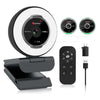
 967Ultra
 Angetube 913Ai
 Angetube 866MAX
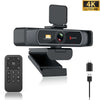
 Angetube 914Max
 PTZ 4K 871Ai
 Angetube @30fps 863Plus
 Angetube @60FPS 873Ai
 Angetube 967Pro
 Angetube 967
 Angetube 862Pro
 Angetube 680C
 Angetube 920
 Angetube 963
 Angetube 962
 Angetube 925c
 862Pro
 863PLUS
 913AI
913AI
Is a 120° Webcam Too Wide? The Truth About Webcam Field of View
by FuJoy on Sep 14, 2026

Have you ever joined a video call and realized that your webcam is showing far too much—or far too little?
Maybe you're sitting alone at your desk, but half of your room is visible.
Or perhaps three people are trying to squeeze into the same webcam frame, while the person sitting on the edge keeps disappearing.
The problem may not be your webcam's resolution.
It may be field of view (FOV).
When shopping for a webcam, you'll often see specifications such as 78°, 90°, 100°, or 120° wide angle. But what do these numbers actually mean—and do you really need a 120° webcam?
Let's find out.
What Does "Field of View" Mean on a Webcam?
Think of your webcam as a pair of eyes.
A narrow field of view is like looking through a small window. You see less of the room, but the subject takes up more of the frame.
A wide field of view is more like opening that window.
You can see:
More people.
More workspace.
More movement.
More of the room.
The field of view tells you how much of the scene your camera can capture. However, manufacturers don't always describe FOV in exactly the same way—horizontal, vertical, and diagonal measurements can differ—so it's worth checking the manufacturer's specifications before comparing numbers directly.
78° vs 90° vs 120°: Which One Actually Makes Sense?
Here's an easier way to think about it.
📷 78° — "Just Me"
Imagine you're sitting at your desk for a normal Zoom meeting.
You don't need to show your entire room.
You simply want:
Your face + shoulders + a little background.
That's where a narrower webcam can make sense.
📷 90° — "Me and My Workspace"
Move a little farther away from the camera, raise your hands during a presentation, or add another person beside you, and 90° starts to become more useful.
It's a good middle ground for:
- Home office
- Small meetings
- Presentations
- Online teaching
📷 120° — "Show Me More"
Now imagine you're sitting in a small meeting room with three people.
With a narrow webcam, someone at the edge of the table may disappear from the frame.
Move the camera farther away?
You may not have enough space.
That's where a 120° wide-angle webcam becomes useful.
A 120° FOV can capture a substantially wider scene and is commonly suited to group meetings, collaborative spaces, presentations, and environments where the camera needs to sit relatively close to the subjects.
So… Is 120° Too Wide?
For some people, yes.
And that's an important point.
A wider field of view isn't automatically better.
If you're sitting 50 cm from your webcam for a one-person video call, a very wide lens may show much more of your room than you actually want.
But if you regularly:
- Work with multiple people
- Move around while presenting
- Teach online
- Demonstrate products
- Stream from a larger setup
- Need to show your desk or studio
then a wider FOV can be extremely useful.
The rule is simple:
Small frame → narrower FOV.
More people or more space → wider FOV.
The "Wide Angle" Problem Nobody Talks About
Here's where things get interesting.
You might think:
"If 120° is good, then 150° must be even better!"
Not necessarily.
The wider the lens becomes, the more carefully the camera needs to control distortion.
With a poorly designed wide-angle lens, objects near the edge of the frame can appear stretched or curved—the classic fisheye effect.
That's why buying a webcam based on the biggest FOV number isn't a great strategy.
A good wide-angle webcam should give you more space without making people look strange.
Current webcam guides also emphasize that FOV needs to be considered alongside distortion control, resolution, and the actual shooting environment.
Why 4K Makes a Wide-Angle Webcam More Interesting
Here's another important piece of the puzzle.
Imagine your webcam captures a much wider scene.
Now you want to crop the image slightly to focus on one person.
If your source image has more detail, you have more flexibility.
That's one reason a 4K wide-angle webcam can be attractive for:
- Live streaming
- Online teaching
- Video production
- Product demonstrations
- Group meetings
- Content creation
A 4K image doesn't magically make every video platform transmit 4K, but the higher-resolution source can give creators more room for cropping and reframing during recording or production.
What About Autofocus?
A wide field of view isn't the only thing that affects how professional your webcam looks.
Imagine you're demonstrating a product to the camera.
You hold the product close to the lens.
Suddenly, your face becomes blurry.
Not ideal.
That's where fast autofocus becomes important.
A webcam with PDAF (Phase Detection Autofocus) can help the camera acquire focus quickly when the subject moves or the distance changes.
For a webcam designed for meetings, streaming, and demonstrations, the combination of:
Wide FOV + 4K + fast autofocus
can be much more useful than simply having a high resolution number on the box.
Which Webcam FOV Should You Choose?
Here's the simple version:
| Your Situation | Recommended FOV |
|---|---|
| Solo video calls | 65°–78° |
| Home office | 78°–90° |
| Two-person setup | 90°+ |
| Small team meetings | 100°–120° |
| Online teaching | 90°–120° |
| Product demonstrations | 90°–120° |
| Streaming setup | 90°–120° |
| Larger collaborative spaces | 120°+ |
These aren't strict rules. Your camera distance and room layout matter just as much.
Who Should Buy a 120° Webcam?
You probably don't need a 120° webcam if you:
- Always sit alone
- Use a small desk
- Prefer a tightly framed portrait
- Don't need to show your surroundings
But you may want one if you:
👥 Work with a team
Keep multiple people in the same frame without forcing everyone into the center.
🎓 Teach or present
Move between your desk and presentation area while remaining visible.
🎥 Create content
Show more of your studio, products, or workspace.
🏠 Work from home
Capture a wider workspace without constantly adjusting the camera.
🎮 Stream
Give viewers more context around your gaming or streaming setup.
Angetube 914Max: Built for a Wider View
For users who want a wider perspective without giving up image quality, the Angetube 914Max combines several features designed for modern video communication and content creation.
It delivers:
4K Ultra HD video
120° wide-angle view
PDAF fast autofocus
Automatic light correction
AI noise cancellation
Dual microphones
The 120° wide-angle lens helps capture more of your surroundings, while 4K resolution preserves detailed video. PDAF autofocus helps maintain sharp focus when you move, and automatic light correction helps balance the image in changing lighting conditions.
In other words, it's not simply about having a 120° webcam.
It's about making that wider view actually useful.
The Bottom Line: Wider Isn't Always Better
If there's one thing to remember from this article, it's this:
Don't buy a webcam because it has the biggest FOV. Buy one because its FOV matches the way you work.
For one person sitting at a desk, 78°–90° may be perfect.
For presentations, group meetings, teaching, and streaming, 100°–120° can give you much more freedom.
And if you want a combination of wide-angle video, high resolution, and fast autofocus, a 4K 120° webcam can be a powerful option.
Your webcam shouldn't make you squeeze into the frame.
It should give you room to move.
FAQ
Is a 120° webcam good for Zoom?
Yes. A 120° webcam can be particularly useful for group meetings, presentations, and situations where you need to capture more of your workspace.
Is a 120° webcam too wide for one person?
It can be. If you mainly make one-person calls from a small desk, a 78°–90° webcam may provide a more focused composition.
What is the best field of view for a webcam?
There is no universal answer. Around 78°–90° works well for many individual users, while 100°–120° is useful for groups, presentations, and wider spaces.
Does a wide-angle webcam distort your face?
A poorly designed wide-angle lens can produce edge distortion. When choosing a wide-angle webcam, look for good lens design and distortion control.
Is a 120° webcam good for streaming?
Yes. A 120° webcam can capture more of your streaming environment, including your desk, background, and movements.
Is 4K important for a wide-angle webcam?
4K can be useful when you want more image detail or flexibility for cropping and reframing. However, resolution should be considered together with lens quality, autofocus, lighting, and frame rate.

